Volume 114 - What is Crystallization in API manufacturing?

Microscopic Magic: Crystals Out of Thin Air

What is Crystallization and Why Does it Matter?

Separations are a critical part of any chemical process; we want to make sure we have a high purity product free of any impurities. Crystallization is perhaps the most powerful tool we have to separate two things. Think of crystallization as the opposite of dissolving. Using crystallization, we take something dissolved in solution and “crash” it out so it becomes solid again. In a later step, we can separate the solid from the liquid. Some key terms for us are:

  • Solute: What is dissolved in solution
  • Solvent: The liquid the solute is dissolved in
  • Mother liquor: The liquid left over after crystallization

Snowflakes: Nucleation in Nature

Crystallization occurs much faster if the crystals have something to grow on. During the winter, water crystals will begin to grow on airborne dust particles, creating snowflakes! The dust particle serves as a foothold for the crystals to grow and is called a nucleus. The process of crystals growing on a nucleus is called nucleation. Once the water starts crystallizing, there is more solid surface for more crystals to grow on, which is also a form of nucleation!

Sweet Tea

Supersaturation

If you’re a fan of sweet tea, you may have accidentally added too much sugar at some point, leaving you with solid sugar at the bottom of your drink that just won’t dissolve. This is an example of a saturated solution, where no more solute will dissolve. However, crystallization uses supersaturated solutions to get the solute to crash out. Have you noticed it’s easier to dissolve sugar in hot water? That’s because both the temperature and solvent determine how much solute you can dissolve!

Types of Crystallization

Cooling Icon

Cooling
Lowering the temperature

Example: Making rock candy by adding sugar to hot water and waiting for it to cool (more on this later!)

Antisolvent Addition

Antisolvent Addition
Adding another liquid in which the solute is less soluble

Example: If you add alcohol to sugar water, you can get the crystals to crash out

Evaporation Icon

Evaporation
Evaporating away the solvent

Example: Extracting sea salt from sea water

Reaction Icon

Reaction
Reacting the solute with something

Example: Hard water build-up can be the result of salts in our water reacting to form less soluble compounds

Try it at Home with Rock Candy!

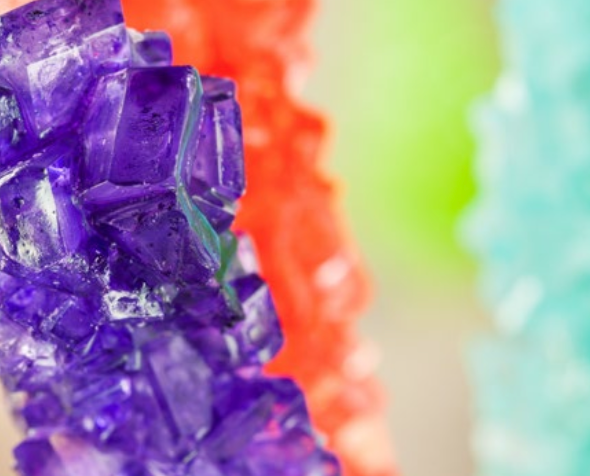
Rock candy is a great example of crystallization suitable for all ages! You can follow this recipe to make it at home What’s happening is you are creating a saturated solution by adding sugar to boiling water However, as the water cools, the solution becomes supersaturated and the crystals want to crash out. The stick serves as a primary nucleation site, allowing the crystals to form faster. Play around with it and see if you can get the crystal size to change by cooling it at different rates!

Why are some of the crystals dark while others are super bright? That’s an indicator of purity! The darker crystals have trapped some of the impurities inside while the bright crystals are high purity, allowing light to pass through!

Crystals

Vision.
Expertise.
Success.

Learn more about the pharma manufacturing processes in our insights section

There was a problem submitting the form. Please try again later.
required

The categories of personal information collected in this form include name, company, and contact information. The personal information collected will be used for exploratory discussions on contract manufacturing, marketing and to perform research and analytics. For more information about the categories of personal information collected by AbbVie and the purposes for which AbbVie uses personal information, visit https://privacy.abbvie.

Thank you for subscribing!

You’ve been added to our list and will hear from us soon.