When you produce a drug, you want to make sure the process is reproducible. Process Validation is the use of “objective evidence” to establish that a “process consistently produces a result or product meeting its predetermined specifications.” You can think of process validation as a playbook consisting of three steps that ensure we can make quality product every time. First, we look at the equipment (IQ), then focus on how it functions in the process (OQ), and finally we bring these two pieces together to do performance qualification (PQ or PPQs). Process validation gives confidence in the repeatability of the manufacturing process and quality of the product.
Mind your PPQs
What is Process Validation?

Installation Qualification
Installation Qualification (IQ) verifies that the equipment and its software & systems have been delivered, installed and configured in accordance with the requirements for manufacturing.
This process checks all the: electrical, pneumatic, water, health, safety, environmental conditions (temperature, humidity), location, equipment operation procedures, calibration, and preventative maintenance plans of the equipment.

Operation Qualification
Operation Qualification (OQ) demonstrates that the process produces conforming product across the range of process inputs.
The main purpose of OQ is to identify and inspect features of the equipment that can influence the final product quality. Examples include: process control limits (time, temp, pressure, line speed, setup conditions), test worst case parameters, yield, sampling, sterilization testing.

Performance Qualification
Performance Qualification (PQ), the final step in the qualification process, demonstrates that the process consistently produces acceptable product under normal operating conditions. During PQ, the plant demonstrates that process is stable and the output from lot to lot is consistent.
Process Performance Qualification (PPQ) Runs are completed in order to satisfy this step of qualification.
Bakery Analogy: Validating Your Award-Winning Cherry Pie (Perfect Slice Guaranteed)

IQ
- Is the oven installed?
- Is it connected to the power?
- Can I open & close the door, use the touchscreen?
- Are the functions (fan, convect, self-clean, etc.) working?

OQ
- Does the oven heat up as it should?
- Temperature remained stable for duration of test?
- Equipment cooled down after shut off?
- Any damage to equipment caused by usage?
PQ/PPQs
- Does the oven still perform as expected with the pie inside?
- Can we use the oven to make multiple batches of pies on different days and get the same result?
PPQ (Process Performance Qualification) Runs
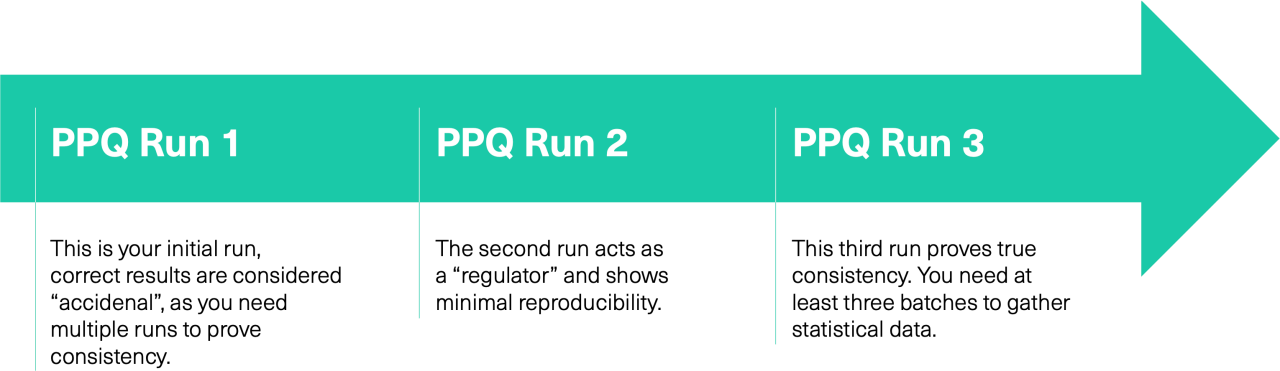
Why Are There Three PPQs?

The PPQs of Process Validation
- Anytime we file a new product
- Whenever we transfer a product to a new manufacturing site
- Material & supplier changes
- Continuous improvements (ex. batch size, fill volume, equipment change, etc.)

The PPQs of Process Validation
- While fewer PPQs may seem tempting, there are risks to balance, both to product quality and the patient
- Batches that do not meet specifications may need to be thrown out or undergo costly rework. Validating three runs provides confidence that the process will meet specifications every time the product is manufactured
Remember our baking analogy... would you change anything in your award-winning recipe or equipment setup and start selling it without verifying that it didn’t impact the product first?
No? I didn’t think so...
Fun Fact: The timing of approvals & shelf life of the product can make PPQ product saleable. This is often easiest to achieve when filing in the US, as the EU usually includes multiple markets and the product can’t be released for sale until all countries approve the filing. Selling PPQ product is a great way to earn back some of the money invested in the validation process!