Safety (Stock) in Numbers: Protecting our Patients
Pandemic-Era Supply Chain Challenges
Since the beginning of the COVID-19 Pandemic in 2020, we have heard of many supply challenges, ranging from PPE to food to raw materials for our products.
Manufacturing plants were affected by capacity issues from labor shortages. Many factories shut down or were forced to reduce production because workers were sick or in quarantine. Some cities saw a major exodus of workers to more rural areas causing even more of a labor shortage.
These labor shortages can cause a butterfly effect on supply chains. Shipping companies also experienced labor shortages which meant even when companies had products back in stock, shipping was delayed for many items.
Port Congestion
A large portion of goods are transported by shipping container each year. During normal operation, containers are continuously loaded, shipped, unloaded and then loaded again. Due to COVID-19 there were many lockdowns and border controls put into place at ports. This caused major congestion in ports all over the world.
This delay in shipping not only causes delays, but also causes price increases. Prices on major trade routes have increased as much as 80% year over year.
Assurance of Supply
Here are some of the ways AbbVie operations is working to protect supply to our patients:
Dual Sourcing
Many products at AbbVie will be manufactured in multiple locations. Dual sourcing ensures that if one supplier is impacted by labor shortage or manufacturing issues, there is another supplier to prevent a shortage.
Capacity Improvements
Creating more capacity for production ensures a larger throughput and can allow for a quicker reaction time for a demand spike.
Safety Stock
Safety stock is an important aspect of any supply chain. Safety Stock is a minimum level of inventory that is held to help cover supply chain shortages and fluctuations in demand. AbbVie has a patient focused mindset and is committed to ensuring patients always have their medication. Safety stock is a tool we use to ensure supply challenges do not translate into patient impact.
Having a stock of product ensures that if production is affected, product can still be supplied.
What is Safety Stock
Although we have many ways to look at demand, it is often hard to predict exactly month to month. Having safety stock in the supply chain allows for small fluctuations in demand to not result in a supply shortage.
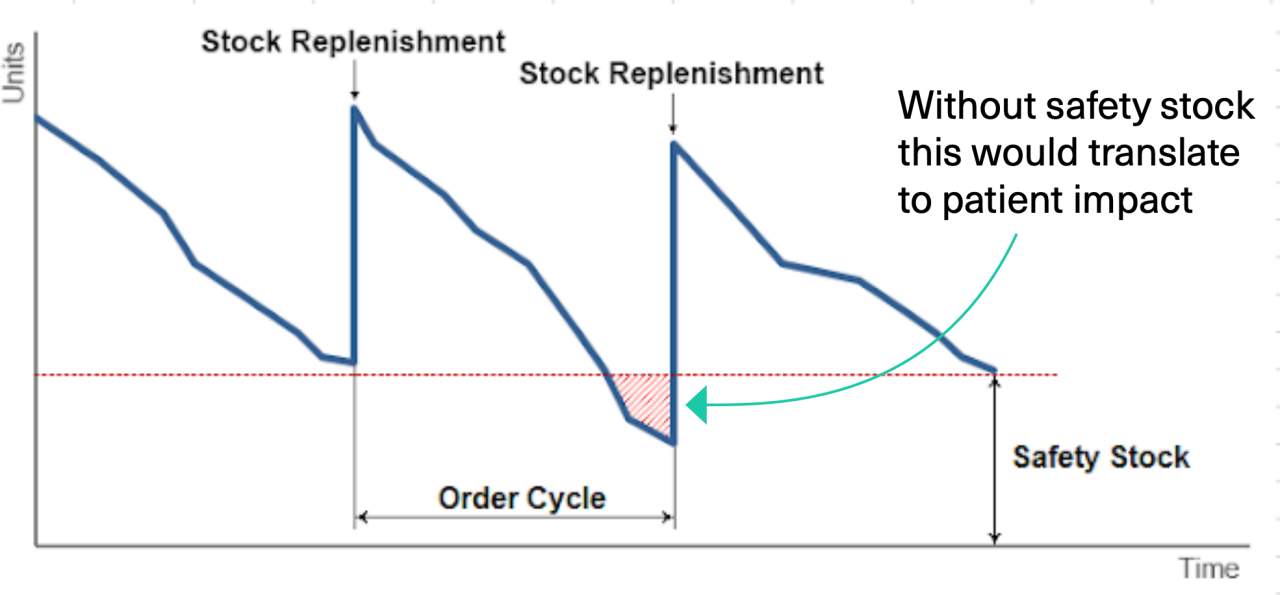
The purpose of safety stock is to give you time to react to supply chain disruptions and changes in demand. It may not cover an extended plant shutdown, or an entire global pandemic, however, it will give you time to react and implement alternate suppliers or supply plans.
Safety Stock in Supply Chain Nodes
Safety stock is not just for finished goods. Although it is good to have the appropriate safety stock for finished products, holding inventory throughout the supply chain can also help to account for demand changes.
Most pharmaceutical products have multiple manufacturing operations (i.e. API, Drug Product, Finished Goods). Holding inventory of API or raw materials will enable faster production times on finished goods should demand increase or supply chain problems arise. This is also a good way to ensure you are holding stock without risk of finished goods expiring in inventory.
How much Safety Stock
Not every product requires the same amount of safety stock. In order to determine how much safety stock is appropriate, there are several formulaic tools that can be applied. Most models are built on similar variables like:
Demand: safety stock should be based off of the average demand. It also should take into account how much that demand fluctuates over time. A product with a more volatile demand usually requires more safety stock to account for spikes.
Order Lead Time: If a product takes longer to manufacture, the safety stock should be increased to account for that. The safety stock should also account for the fluctuation of the lead time. If the typical lead time is 3 months but sometimes the orders can take 4 months, safety stock should take that into account.
Product Expiration Date: The safety stock should not exceed the expiration dating of a product. You want to be able to use all your inventory and if your safety stock is too high, you risk product exceeding the expiration date before it can be distributed.
Customer Service Rate: The more safety stock you have, the higher customer service rate you will be able to support. For example, do you want to meet 90%, 95%, or 99% of customer orders? To meet more orders, a higher amount of safety stock is required.
Safety stock determinations are not designed to eliminate all stockouts – just most of them. Although demand variation is the main driver of safety stock determinations, a balance between all variables is required to ensure appropriate levels.